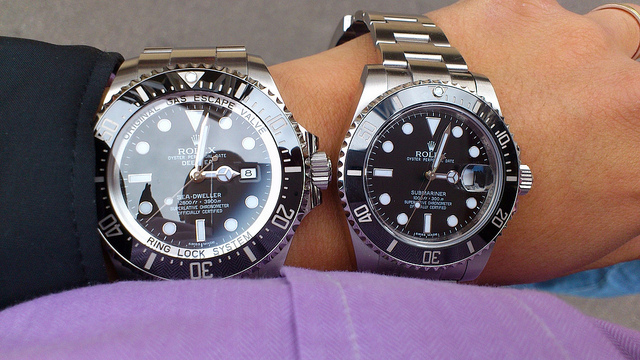
Rolex has unparalleled brand-name recognition for a reason: they make excellent, world-class watches and they have consistently gone their own way in more ways than one. When other Swiss companies were trying to reinvent themselves as makers of cheap quartz watches just to stay alive, Rolex followed a different path. They elevated their game and redoubled their efforts to become the largest and most successful maker of luxury watches in the world. It was a typically shrewd move and guaranteed their success and survival during the “quartz revolution” era that saw the demise of so many old and respected Swiss watch companies. Today everybody knows a Rolex equals an expensive luxury watch. What a lot of people don’t realize is that Rolex pretty much invented the modern wrist watch. That’s one of the reasons they are ROLEX.
Here are a few more things you may not know about the giant from Geneva.
1. Rolex Is a Privately-Held Company
One of the little known secrets of their success, Rolex isn’t beholden to stockholders and therefore the company doesn’t pander to fads and short-term concerns. They are not slaves to current trends. They can take the long view and make their product upgrades gradually over time without rushing anything into production. They’ve been called the Mercedes Benz of watches and their product line evolution has been called glacial in its pacing. That’s why their watches don’t look dated in five years. Rolex prefers to introduce perfect upgrades and to produce perfect watches in general. One thing you must understand about Rolex is this demand for perfection. The privately-held company has billions in cash reserves and could be equated to the Apple of the luxury watch industry. In fact, if Steve Jobs had started a watch company in Switzerland a hundred years ago, it would probably have been called Rolex.

2. Rolex Uses The Best of Everything
In their quest for perfection, Rolex uses the best of everything. They do this because: a) they can afford to and b) it ensures their product is a superior one. They x-ray all their diamonds even though in all the years they have been doing so, only two in 20 million have been found to be fake. They are the only watch manufacture that has its own in-house foundry. That’s right—they make their own gold and platinum in-house to ensure its quality. All watch aficionados know Rolex has for years used a proprietary stainless steel called 904L. They do this when every other watch manufacture in the world uses the ubiquitous and very serviceable 316L. Why would Rolex do this when 904L is known to be both more expensive and harder on machine tools? They do it because 904L steel is more corrosion resistant (better) and holds a polish better than 316L. Rolex makes enough watches (upwards of a million a year) that it made sense for them to upgrade their tooling to work with the tougher steel to produce a better product. Many companies would have continued making perfectly acceptable watches with the cheaper steel and sent the extra profits to their shareholders. See point number one above.
3. Rolex Is Obsessive About Quality
Rolex continues to send out hundreds of thousands of movements a year to independent testers for chronometer (COSC) accuracy testing. That’s where the ‘Superlative Chronometer Officially Certified ’ on the dial of a Rolex comes from. Rolex continues to pressure test all their dive watches like the Submariner and Deep Sea in actual water pressure tanks, unlike most other manufacturers who are content to use cheaper air chambers. Contrary to popular belief, all Rolex watches still receive meticulous hand work during all aspects of production. This despite the fact that Rolex has the most automated and high-tech watch manufacturing facilities in the world. They continue to employ humans where humans do the best work, and let the machines work their magic where they are best suited. It’s a great system and very pragmatic. Rolex has been attempting for decades to manufacture as many parts as possible in-house and are close to achieving 100 percent control. These days only the sapphire crystals and some dial hands are outsourced and the hands will be made in-house within a few years, according to Rolex. They do this not out of some obsessive mania for control but to ensure the quality of their product. The real secret of Rolex’s success isn’t brilliant and deep-pocketed marketing (as so many of their competitors would like to believe) but rather the relentless Rolex pursuit of perfection. It may be an elusive, even impossible goal to strive for, but Rolex evidently considers it worthwhile to try.